
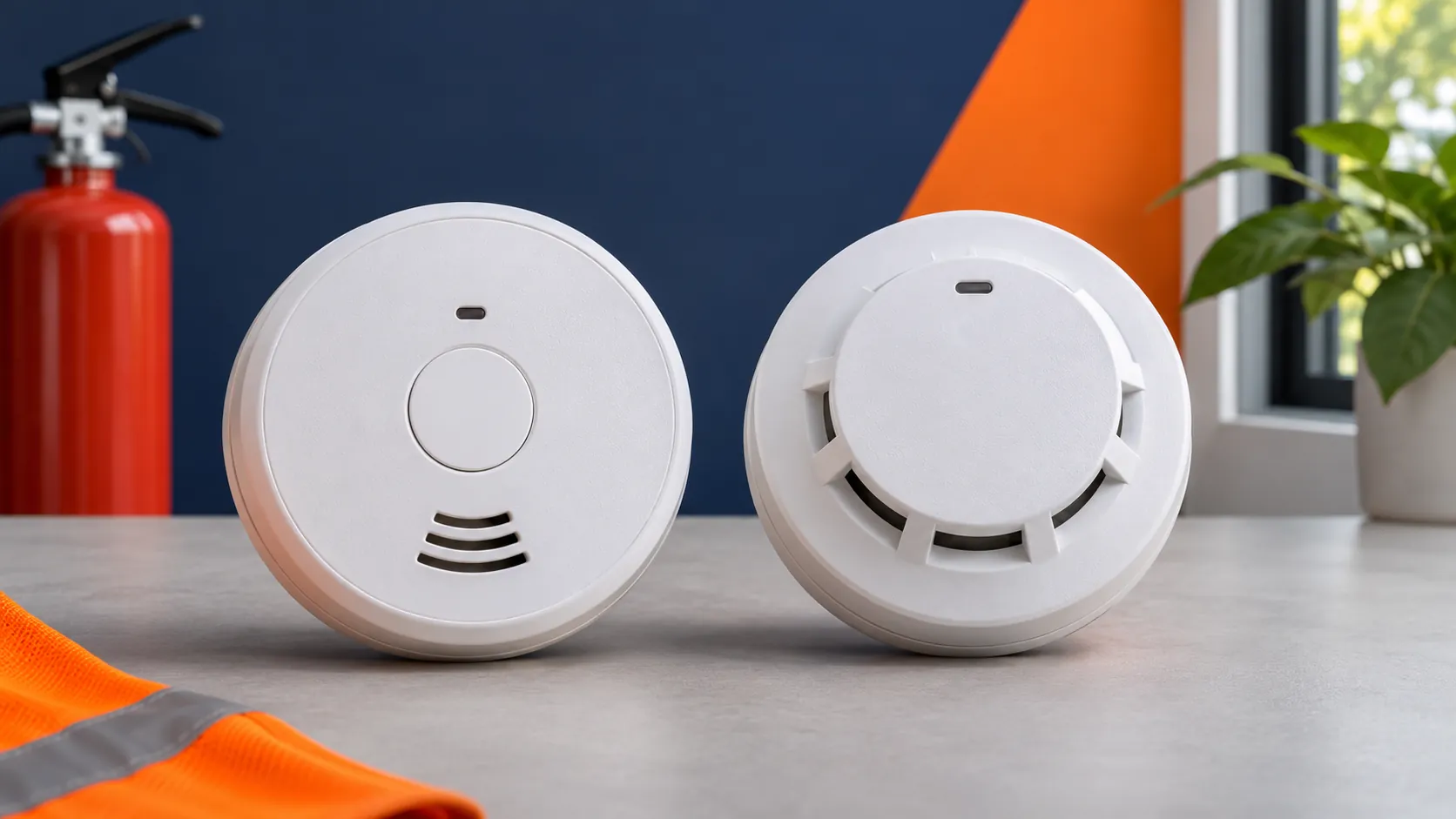
Photoelectric and ionization are two ways a smoke alarm can sense smoke. Photoelectric alarms tend to respond faster to a slow, smoldering fire. Ionization alarms tend to respond faster to a fire with flames. A smoldering fire can make smoke before you see flames. Both types can detect smoke from either kind of fire, but their response times can vary. U.S. Fire Administration position statement
No one can predict how a fire will start. The U.S. Fire Administration (USFA) recommends both types in homes and other places where people sleep. You can use separate alarms of each type or a dual-sensor alarm. A dual-sensor alarm uses both methods to sense smoke. Check local rules and the maker’s instructions for the selected device. USFA: Smoke Alarms
Quick comparison
| Question | Photoelectric | Ionization |
|---|---|---|
| How does it sense smoke? | Smoke changes how light moves inside the alarm. | Smoke changes a small electric current inside the alarm. |
| What is its common strength? | It tends to respond faster to smoke from smoldering fires. | It tends to respond faster to smoke from flaming fires. |
| Can it sense the other kind of fire? | Yes; response depends on the fire and the device. | Yes; response depends on the fire and the device. |
| Does sensing type tell you the power source? | No. Check the exact model. | No. Check the exact model. |
These are general trends. They do not guarantee how a product will respond to every fire. The National Institute of Standards and Technology describes how the two sensing methods work and why their response can differ. NIST: How Do Smoke Detectors Work?
Which type should I choose for a home?
For a home or other place where people sleep, USFA recommends both photoelectric and ionization technologies. That may mean a dual-sensor smoke alarm or separate alarms of both types. Check the model label and manual to confirm what is included. Follow local rules and the installation instructions for the specific devices; do not remove working alarms while you are planning a change. USFA position statement
A dual-sensor smoke alarm is not automatically a carbon monoxide alarm. Carbon monoxide (CO) is a dangerous gas you cannot see or smell. If you need CO protection, check that the alarm is designed and marked for CO. You may need separate CO alarms. Follow local rules and the device instructions.
How do I identify the type I already have?
When it is safe, look for the brand and model number on the alarm or in its paperwork. Search the manufacturer’s manual for “photoelectric,” “ionization” or “dual sensor.” The label may use symbols or short forms. Ask the maker if the label is unclear. The shape, color, test button and battery type do not reliably identify the sensing method. Do not take the alarm apart to inspect its sensor.
What does “smoldering” or “flaming” mean?
A smoldering fire burns slowly. It can make smoke before you see flames. A flaming fire has visible flames. Real fires can change as they grow, and materials, room conditions and alarm designs affect the outcome.
The comparison describes a general response trend, not a promise that one alarm will always warn first. USFA notes that both technologies can detect smoke from either type of fire, and the difference in warning time varied in full-scale tests. This is why USFA recommends both technologies rather than relying on a simplified “one type for one fire” rule. USFA position statement

How does a photoelectric smoke alarm work?
A photoelectric alarm uses light inside a small space. When smoke enters that space, it can cause light to reach a sensor. This can trigger the alarm. The exact design and features depend on the product. A photoelectric sensor does not by itself tell you whether an alarm has a replaceable battery, wireless links or a particular approval.
How does an ionization smoke alarm work?
An ionization alarm checks a small electric current inside the device. Smoke can change that current and trigger the alarm. As with photoelectric models, the buyer must check the exact unit’s power, features, marking and manual.
Does a dual-sensor alarm also detect carbon monoxide?
Not automatically. Dual-sensor can mean that an alarm uses both photoelectric and ionization methods for smoke. A smoke-and-carbon-monoxide alarm is designed to warn about both dangers. These are different descriptions. Check the exact model’s label, instructions and applicable approvals before assuming either capability.
How an alarm senses smoke and how it gets power are separate questions. Either type may use a replaceable battery, a sealed battery or building power. Check the exact model. For the next step, read how to change a smoke detector battery.
Is a smoke alarm the same as a smoke detector?
People often use the terms as if they mean the same thing. In a technical purchase, it helps to ask what the buyer needs. A standalone smoke alarm senses smoke and sounds a warning at the unit. A smoke detector can mean a sensor used as part of a building fire-alarm system. Confirm the product and system requirements before quoting.
Where should alarms be placed?
Where alarms are placed and whether they are connected also matter. USFA advises smoke alarms inside each bedroom, outside each sleeping area and on every level of a home, including the basement. It also recommends connected alarms. If one detects smoke, the others can sound too. Follow local requirements and the selected product’s installation instructions; use a qualified electrician for hardwired installation. USFA installation guidance
Not every smoke alarm can connect to others. Check this feature before buying. Check whether the model can connect to the system and other units you plan to use.
What should a distributor check before ordering?
Ask for information tied to the exact model and configuration, including:
- Sensing type: photoelectric, ionization or dual-sensor.
- Power source, battery type and whether users can replace it.
- Test button, fault signals, service-life instructions and any interconnection feature.
- Model marking, test documents and requirements for the destination market.
- Manual language, package contents, quantities and branding options.
For U.S. projects, the required standard depends on the product and application. UL Solutions identifies UL 217 for smoke alarms and UL 268 for smoke detectors used in fire alarm systems. This distinction is a starting point for checking requirements, not proof that a particular product is certified. UL Solutions: Fire, Smoke and Gas Device Certification
A practical document check for U.S. buyers
A product name is not the same as evidence. When requesting an alarm or a system detector, ask for a model-specific label, instructions and proof of the standard required for that product and market. Check that the manufacturer name, model number, version and any listed accessories match the item in the quotation. Ask who to contact about expiry, faults and replacement parts.
Do not treat a European claim, a photo of a certificate or a different product’s listing as proof that this exact unit is approved for the United States. Confirm requirements with your customer, the relevant authority and the appropriate certification provider.
Frequently asked questions
Is photoelectric always better than ionization?
No single type is best for every fire. Each has different strengths, and response can vary. Follow fire-safety guidance, local rules and the instructions for the selected products.
Is a photoelectric alarm always battery-powered?
No. Sensing method and power source are separate features. Check the exact model.
Do both types need cleaning and testing?
Yes. Follow the manufacturer’s instructions for the exact alarm. USFA recommends monthly tests for home smoke alarms and advises users to follow the device’s care instructions. A test button checks what the manufacturer describes for that model; it does not replace every inspection or local requirement. If the alarm makes a short repeated sound, see our guide to why smoke detectors beep.
For a bulk enquiry, visit our smoke alarm product page. The sensing type, power and approvals of the final supplied model must be confirmed.